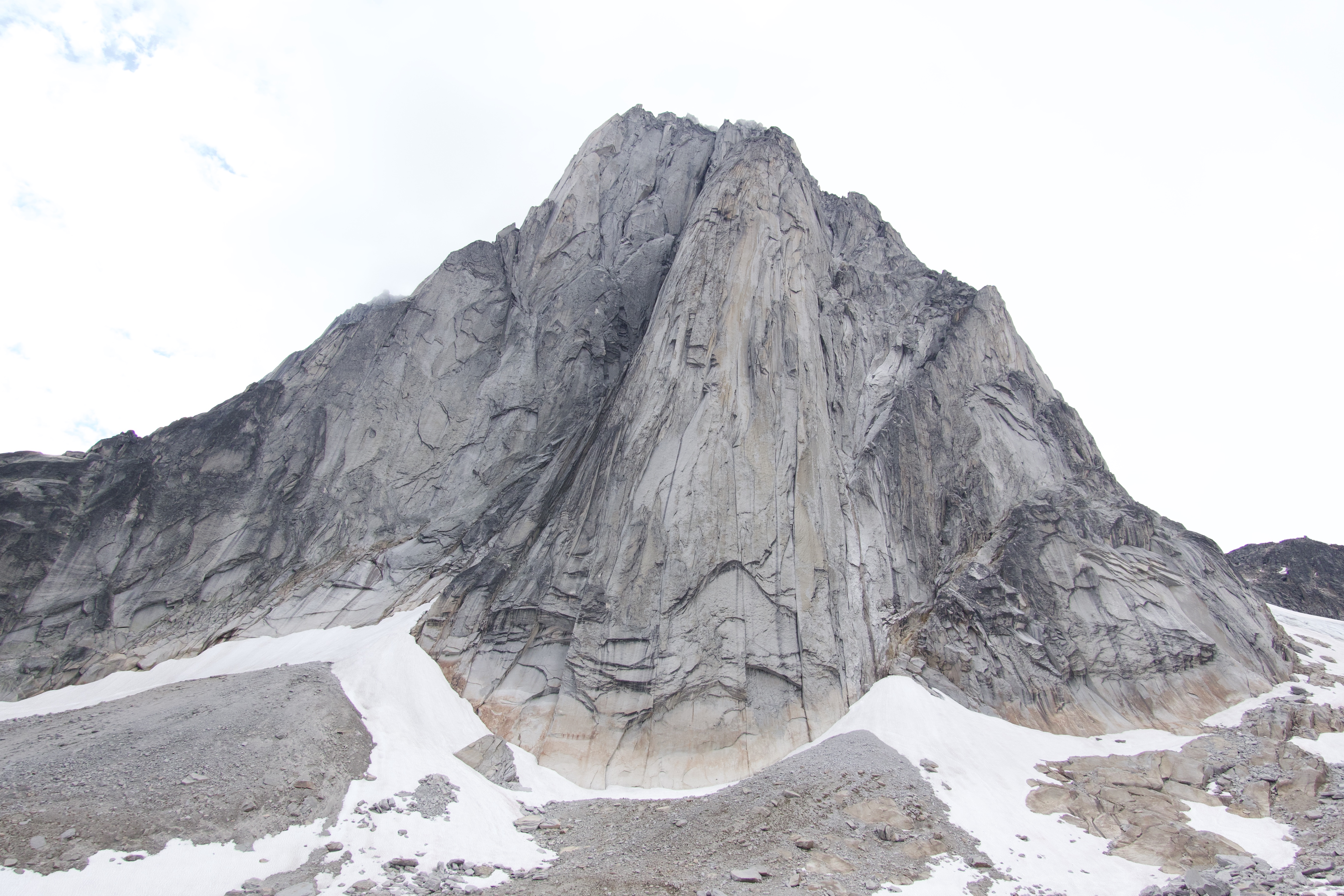
Goldmine
I’d heard the name “Bugaboos” long before I ever set foot in the range, and even longer before I stood atop the incredible South Howser Tower. The story goes that early miners came here looking for gold, silver, maybe some rich mineral veins to strike it big. They found nothing. Frustrated, they called the whole place “a bugaboo,” an old term for something worthless, and moved on. From a climber’s perspective, they couldn’t have been more wrong.
Today, the Bugaboos are a mecca: ski touring in the winter, big alpine rock climbs in the summer. Towering granite spires rise straight out of dramatic glaciers, their faces catching the light like giant blades. The setting is so improbable, so striking, I’ve heard it almost looks fake. The range had been lodged in my mind’s eye for years, but the mountains had a way of keeping me out.
Two Tries, No Touch
The Beckey-Chouinard is a true classic, beckoning climbers from around the globe to scale its 15 pitches of sublime alpine granite. But, as I now know all too well, the remote setting and fickle weather are as much of a challenge as the climbing.
My first attempt on the world-famous route was five years ago with my friends Mike Brumbaugh and Charley Mace. We staged near Banff, waiting out a stretch of bad weather. Eventually, we got a marginal break and loaded a helicopter bound for East Creek Base Camp. The chopper rose up over the forest, banking toward the Pigeon–Howser Col, and then stopped cold. On the far side of the col, a ground blizzard raged, an opaque wall of white. We turned around. Strike one.
A couple years later, I tried again with Felipe Tapia-Nordenflycht and Nick Martinez. Same story: fickle storms, intermittent rain, the range locked in winter’s grip even in late summer. Just days before we were scheduled to fly in, the rangers sent us a photo of our objective plastered in three feet of snow. “Don’t bother,” they said. “It won’t be in condition for weeks.” Strike two.
The Waiting Game
This summer, I was keen for a third and hopefully final attempt. My partners were Nick again, plus Lenore Sparks. We drove to Invermere, a couple hours shy of the Bugaboo Lodge, and then… waited. And waited. The weather was stubborn, a sullen mix of rain squalls and low clouds that prevented us flying in. We killed time sport climbing at a crag where the mosquitoes were so bad we practically bathed in DEET. We kayaked the upper Columbia River (yes, the same Columbia that winds all the way to Oregon, but here it’s a newborn, just starting its journey). We organized, reorganized, and stared at forecasts.

Photo credit: Nick Martinez
Finally, after a week, we had a sliver of a window. Not a great forecast, but better than nothing. In the mountains, and particularly in the Bugaboos, you take what you can get.
East Creek and a Cold Start
We flew into East Creek on a bluebird afternoon, the helicopter weaving between spires. Camp was just a couple hundred yards from the drop-off, a pile of rocks above the glacier, wind-swept and stark. That night it rained, but we told ourselves the wind might dry the wall. We set alarms, but when the pre-dawn cold hit our faces, we knew there was no need for alpine-start heroics. We left camp at 7 a.m., aiming for a planned bivy halfway up.
Caption: Helicopter circling the South Howser Tower before ladning at East Creek. You can spot the route from above.
Video credit: Nick Martinez
The approach wound through talus and up a ramping ridge to the base of the climb. The wind was howling. For a moment, I wondered if we were being reckless. But in climbing, when you’ve come this far and the door’s still cracked open, you step through. We promised ourselves we’d keep an open mind, turn back if needed, rappel off, and leave gear. It was time to rope up.

Photo Credit: Nick Martinez
Pitch by Pitch
P1–P3: The opening pitches were a warm-up: 5.5 ridge climbing, cracks and flakes to gain the crest, the rock clean and cold under my hands. We moved quickly, stretching each rope length to the max.
P4: A bulge with a finger and hand crack: 5.10 and sharp on the fingers, then back into easier ground. The wind bit at every belay. I kept my big Arc’teryx synthetic jacket zipped to my chin.
P5–P8: Cracks, flakes, a left-facing dihedral, and a big, scree-covered ledge. Lenore floated up the 5.8 sections; Nick moved like he’d been born on the rock wall. Every belay felt like a checkpoint in some big, slow-motion race.
P9–P10: Chimneys and blocks, a short but tricky crack, a traverse between opposing dihedrals. I moved by feel: cold granite, sharp edges, the steady rhythm of my partners calling out the terrain ahead. After a long day, with Lenore leading every pitch in a heroic effort, we reached the bivy ledge. Our home for the night was as advertised: flat enough for a few pads, with a short rock wall for shelter. We strung a tarp, brewed hot drinks, and settled in. By alpine standards, it was downright luxurious.

Credit: Nick Martinez

Credit: Nick Martinez

Credit: Nick Martinez
The Hard Pitches
Morning brought calmer air. We packed quickly and launched onto the upper wall, with Nick taking the sharp end for the remainder of the climb.
P11–P14: The Great White Headwall. Strenuous hand and fist cracks in perfect corners. The squeeze on P12 was tight but passable with packs on. P13’s 5.9 crack flowed into the long right-facing dihedral of P14. The granite was flawless — blind climbing heaven. Crack systems are my guide ropes in stone.
P15–Top: The finale was a wild one: traverse left on thin holds, a difficult move around an arete, then a pendulum. A fixed line dangled; I grabbed it, swung left into a gully, and climbed on. Above, a lower angle ridge guarded the summit, but it wasn’t an easy jaunt. We had expected a mellow romp to the top, but instead found long 4th and low 5th class pitches with scary, wet bouldering problems interspersed. It’s not over till it’s over!

Photo credit: Lenore Sparks

Photo Credit: Nick Martinez
Summit and the Storm
At the top it was raining and snowing. We found weathered slings and the first of the rappel anchors. The descent was a gauntlet: 10 rappels, each one a step deeper into the storm. Rain turned to hail, snow swirled in gusts, ropes froze in our hands. My mantra became simple: I’m okay. I’m going to be okay. Step by step.
Near the glacier, we confronted a yawning bergschrund, the crack that forms where snow meets rock. These melted and malformed maws are dangerous, and often the most difficult part of accessing or getting off a mountain. We swung out, punching fists into snow to haul ourselves around the lip and onto the ice. Midnight found us descending a boulder field in the dark. Every step was loose rock and blind guessing. Of course, I’m used to descending in the dark, but some light would have been nice for my sighted partners! I slipped hard, nearly breaking one of my cherished and critical custom Leki poles.

Photo credit: Lenore Sparks
Off-Route and Bivouacked
We funneled into a drainage, unsure if it was the right one. The uncertainty was too much. We stopped. Lenore spotted a sliver of a bivy cave, barely enough for three people. All our sleeping pads had popped on the rocks. We curled up like pretzels: Nick on Lenore, Lenore on me. Dinner was a candy bar split three ways.
Morning was a stiff, shivery crawl out of the cave, and a confirmation of our decision to stop the night before; below us, the terrain turned to an ice and serac-riddled cliff dropping 1000 feet into the void! We brewed “gummy tea” — hot water poured over shot blocks — and chewed a couple pieces of dried mango. Then we climbed back to the col, down steep snow and loose scree, onto the lower glacier, across the boulder field, and finally back to East Creek camp.

Credit: Nick Martinez

Photo: Nick Martinez

Photo Credit: Lenore Sparks
Gratitude
This climb wasn’t just about the summit. It was about the people tied into the rope with me.
Nick Martinez — strong, steady, and as competent an alpinist as you could hope to have in a storm.
Lenore Sparks — a 5.13 rock climber who can also carry a heavy pack through any terrain, still smiling at the end. Without them, I wouldn’t have stepped onto this wall.
Thanks to Canadian Mountain Holidays for flying us in, and to Leki USA for rushing me those extra-long poles. On steep snow and talus, they’re my lifeline.

Reflection
I’m 56 now. My career as a professional climber is slowly winding down, but the fire still burns. This route was a full-value epic: Type II fun through and through over 2,000 feet of perfect granite. The weather window was slim, the terrain was treacherous, and we suffered plenty. But the climbing itself, pitch after pitch of splitter cracks, was a reminder of why I still tie in.
Climbing blind is about more than just upward movement. It’s about trust: in my hands on the rock, in my feet finding smears, in my partners keeping me safe. It’s about committing to a path when the outcome is uncertain and knowing that success, if it comes, will be sweeter for the struggle.

Photo credit: Nick Martinez
Type I Fun Awaits
After days of wind, snow, cold, and granite, I’m switching gears. Now comes the other kind of fun, Type I. I’ll trade my harness for a swimsuit, the smell of wet down for sunscreen, the endless granite for a quiet lake with my family. We’ll feel the stress of the mountains dissolve in ripples on the water.