Our No Barriers Summit was held in June in one of the most beautiful places on Earth, Squaw Valley, California, near Lake Tahoe: tall snow-capped peaks, huge Ponderosa Pines, giant pine cones as big as pineapples, fast-moving mountain creeks, all spilling down granite slopes into clear cold Lake Tahoe. Everyone should put it on their places-to-see/hear/smell list. So, after experiencing this gem, I decided to go for the California trifecta.
Last winter, I met Joe Wolner while skiing in the Sierras. We of course started talking skiing, and I told him my unrealized goal of skiing Mt. Shasta, one of California’s 14,000 ft peaks and the southernmost volcano in the Cascade range. Steep terrain and consistent snowpack well into the summer months make for a ski-mountaineers dream.

Turns out, Joe works with disabled skiers at Achieve Tahoe, an adaptive ski program. He’d also climbed and skied Shasta dozens of times, and he generously invited me out for a climb and ski descent of the West Face. The chance meeting was incredibly fortuitous, connecting with one of the region’s foremost authorities on snow conditions, route options, and blind skiers. On a prep call, Joe mentioned that we’d start at Bunny Flats – just under 7,000 feet and do a one-day climb straight to the summit – no bivvy. I paused, wondering if I could even ascend 7,500 feet in one day, but Joe seemed very confident it was possible.
I left the parking lot with Joe, Skyler Williams, and Bob Kauffman at 2:00 AM and started skinning uphill through the woods. At about 10,400 feet at Lake Helen we put the skis on our packs and traded up for crampons. Around noon, we staggered on to the summit with a crushing wind, the strong smell of sulfur, and the knowledge we were standing in one of the world’s most powerful spiritual vortexes; I think I may of felt a little of that energy, but I was mostly feeling spanked from the nine hour climb.


Hiking back down to the West Face, it was way colder and windier than expected. The snow conditions were super firm and windblown. I was pretty nervous about skiing the West Face and having second thoughts. The descent starts at about 40 degrees. I said out loud, “this might be some hideous ski conditions.” Joe replied confidently, “have faith young man. I think it’s going to beat your expectations.” And Joe was right.

For the next five hours, we skied a nearly endless carpet of tiny snow pellets which skiers call “corn snow.” The West Face is perfect blind guy skiing with wide snow slopes, some a quarter mile wide. Skyler said I could make any kind of turns I wanted and skied down ahead several hundred turns as I followed the faint sound of his calls – “hup, hup, hup.” Funny words for normal life, but “hup” is an easy word to yell and doesn’t wear out your voice as other tones.


At the end of the day, Joe’s Strava reported we’d hiked 18 miles and ascended/descended over 8,000 feet. I was ready for a cheeseburger! Thanks to Joe for all his expertise and belief that we could pull this off.

Next, I headed to Yosemite Valley, a place with a lot of meaning in my life. Way back in 1996, I’d spent a summer in the valley getting ready for a climb of the Nose on El Capitan. Hans Florine, the long-time speed climbing legend of El Cap, was our leader. Since then, Hans has become one of my best friends, mentors, and confidantes. So it’s been fun to meet up for other Yosemite adventures like the East Buttress of El Cap.

For this trip, Hans drove out from the bay to meet me and my friend, Connor Koch. Connor worked for me for four years and in that time became an excellent climber; even though very good climbers struggle in the valley on the slick granite and awkward cracks, I knew Connor was ready. Hans was currently fighting back from a fall on El Cap when a piece of pro popped out of the crack on the Pancake Flake, about 2,000 feet up. Hans fell 16 feet, hitting a ledge on pitch 23 and shattering his feet and ankles. He was in a wheelchair for many months, and despite the pain and uncertainty, I never heard him complain. He attacked this new challenge with the same self-reliance, optimism, humility, and resiliency as he attacked the Nose, reaching the top in 2 hours, 23 minutes and 43 seconds. So I was touched when Hans came out to meet us.


I was on a mission to revisit some climbs I’d tried in the 90’s; during a very hot July, we’d headed up a south facing route called “Serenity Crack and Sons of Yesterday,” a super famous 8-pitch crack climb right above the iconic Ahwahnee Hotel. The dark rocks absorbed the sun, cooked my black rubber climbing shoes, and boiled my feet inside – like stewed tomatoes. We’d been experimenting with using a haul bag and brought it on the route. At the belay station, we tried to retrieve our water, but in a bone-headed move we had buried it at the bottom of the very deep rubber bag. Our leashes connecting us to the anchor prevented us from accessing it. We turned ourselves upside down, diving into the bag, but to no avail. Hot day, boiling feet, and no water – we headed down after two pitches. At the bottom I threw up from heat exhaustion.
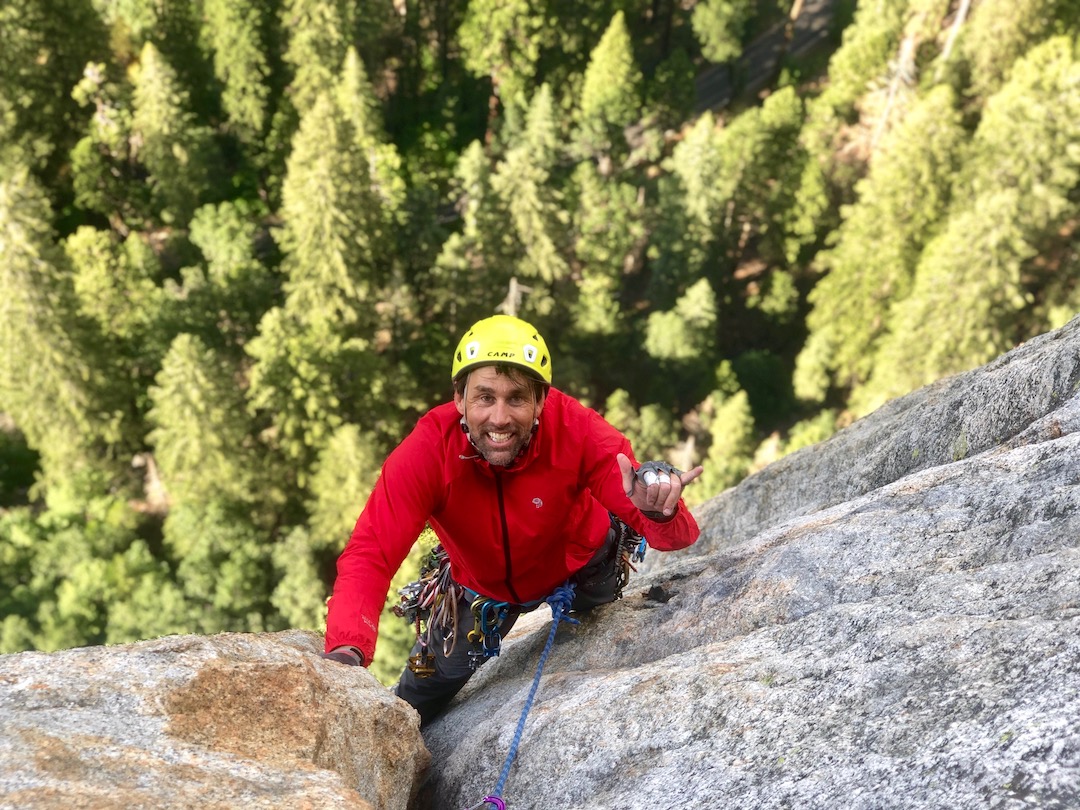
Now we were back, with the hope to surpass the first experience. It was awesome to hear Connor take the lead on some tricky pitches, persevering through very awkward off-width cracks. And of course it was a privilege to climb with Hans who I’d hear grimace in pain from jamming his still-healing ankles in the cracks. “If a blind guy can climb with a smile on his face,” Hans proclaimed, “then I can endure some ankle pain.” This time we topped out and celebrated with an “El Capitini” in the Ahwahnee bar.


The next day we headed to “the Central Pillar of Frenzy,” one of the valley’s most classic climbs. I remembered this climb as steep, slippery, strenuous, and a lot of awkward tenuous movement. On the first pitch, a slick chimney, I was grunting and sweating my way up, breathing as hard as sprinting a hundred-yard dash. Glad to know my memory from 20 years ago isn’t failing me – still strenuous and awkward! With sore feet and dry mouths, we reached the top and rappelled back to the valley floor.

Even though our day was joyful, we were confronted by the sad reality and inherent dangers of this sport. We encountered a Ranger cleaning up the rock face after a woman fell to her death a few days earlier. It made us pause, say thanks for the precious time we have, and check our knots and anchors even more carefully.