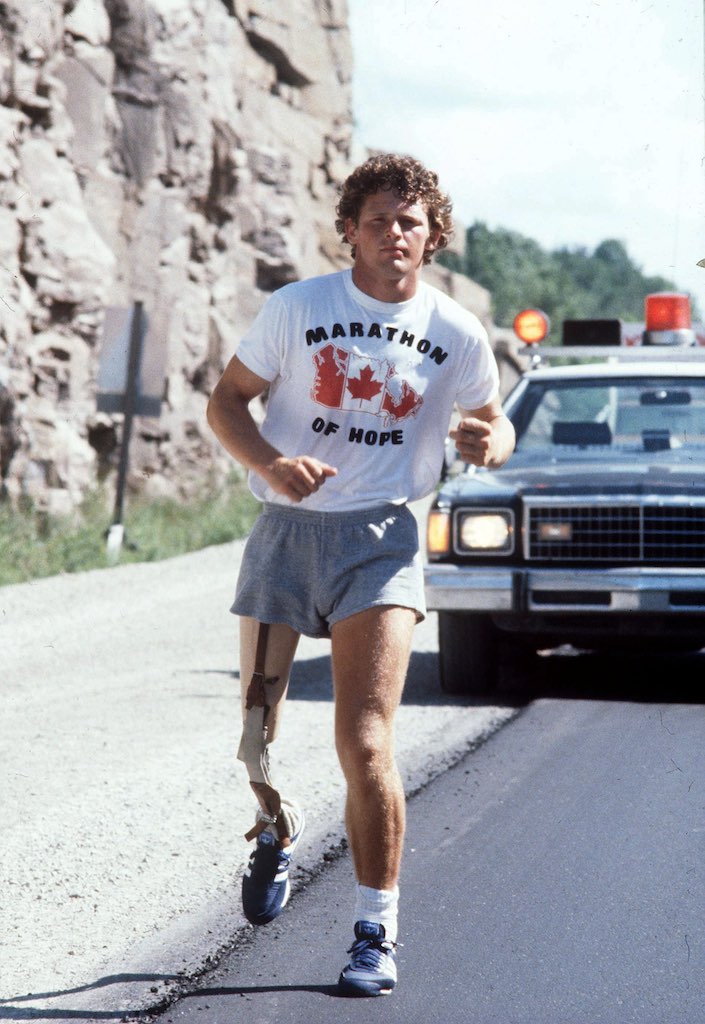
Yesterday was the 40th anniversary of Terry Fox’s “Marathon of Hope.” Terry was a young Canadian who lost a leg to cancer. Instead of shrinking under this tragedy, he set out to run across Canada, determined to give a voice to those suffering, especially the kids he saw beside him in the hospital after his amputation.
While I was losing my vision as an adolescent, I watched Terry run, and it affected the trajectory of my entire life.
Check out this excerpt from my latest book, No Barriers:
“Right before the last traces of my eyesight were gone, I was watching TV. I could barely see out of my right eye, with just a little peripheral vision remaining. To see what was happening, I had to put my face almost against the screen, so close I could feel static electricity crackling on the tip of my nose. I was watching my favorite show, That’s Incredible! That night, they were featuring the story of a young Canadian named Terry Fox. He was nineteen years old when he was diagnosed with cancer. A tumor appeared in his right leg, and he was rushed in for surgery, where his leg had to be amputated six inches above his right knee. In the hospital recovering, Terry watched children even younger than he was succumbing to disease, and their deaths were a searing pain, sharper than the saw that had taken his leg. Of course, he felt for their pain, but his next act was the most surprising thing I’d ever seen. After enduring eighteen months of chemotherapy and witnessing all that death and tragedy, he should have been reduced. As he contemplated his own mortality, he was supposed to retreat, curl into a ball, and protect the precious little he had left. Who would have blamed him? Yet instead, Terry did the exact opposite. He made the astonishing decision to run, and not just for a day, or a week, but from one shore to another, through every province, across the entire country of Canada. It was a marathon a day for thousands of miles.
I pressed my face against the television watching Terry hobble mile after mile in his “Marathon of Hope.” This was before the days of high-tech flex feet and “smart,” computerized prosthetics. His clunky, old-fashioned steel and fiberglass prosthetic leg created a herky-jerky gait, an awkward double-step, and a hop on his good left leg as his prosthetic right foot went back and then swung forward, almost like he was skipping. The look on his face was a contradiction, exhaustion mixed with determination. In his eyes, I sensed something I could only describe as a light that seemed to give intensity and power to his gaunt expression. At first, as Terry ran from town to town, only a few people paid attention, but soon, as news of his daily marathon spread, supporters began to line the roads to cheer him on. By the middle of his journey, throngs were showing up in the thousands.
Later in the piece, the host came back on and said that on day 143—after running an average of twenty-six miles a day for over four months and 3,339 miles through six provinces, Terry was forced to stop his run. Cancer had invaded his lungs, causing him to cough and gasp for air as he ran. Terry cried as he told the crowd of reporters that he wouldn’t be able to finish, but through his tears, he said, “I’ll fight. I promise I won’t give up.”
Terry Fox died seven months after he stopped running. It wasn’t fair. He’d only gotten 22 years on earth. But in that short window, he had made a decision to run, and that decision had elevated an entire nation. Instead of shrinking away, Terry had gotten bigger. He had lived more than he had died. Donations to his Marathon of Hope Fund poured in and reached $24 million, equal to a dollar for every Canadian citizen.
I knew that my blindness was coming. It was a hard fact, and nothing I did would prevent it. As Terry’s story concluded, I knelt with tears pouring down my face. I yearned for that kind of courage, and I dared to hope Terry’s light existed in me.”
Though cancer returned to Terry and he never finished his run, his legacy carries on through the “Marathon of Hope.” Today, the Terry Fox Foundation has raised nearly a billion dollars for cancer research, positively and profoundly impacting countless lives throughout the world.
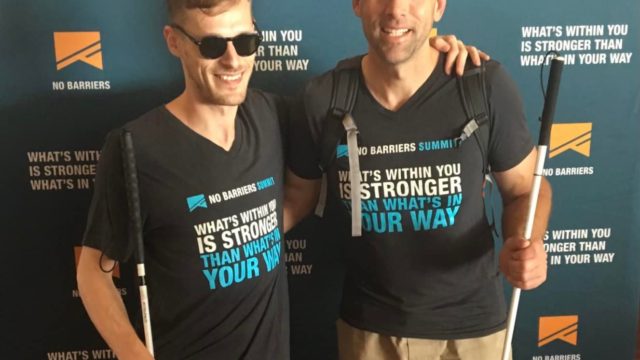
Terry’s example thrust me forward amidst what were some of the hardest days of my life. What challenges are you up against and how will you work to harness that adversity to create a life of meaning and purpose? Take the No Barriers Pledge.